
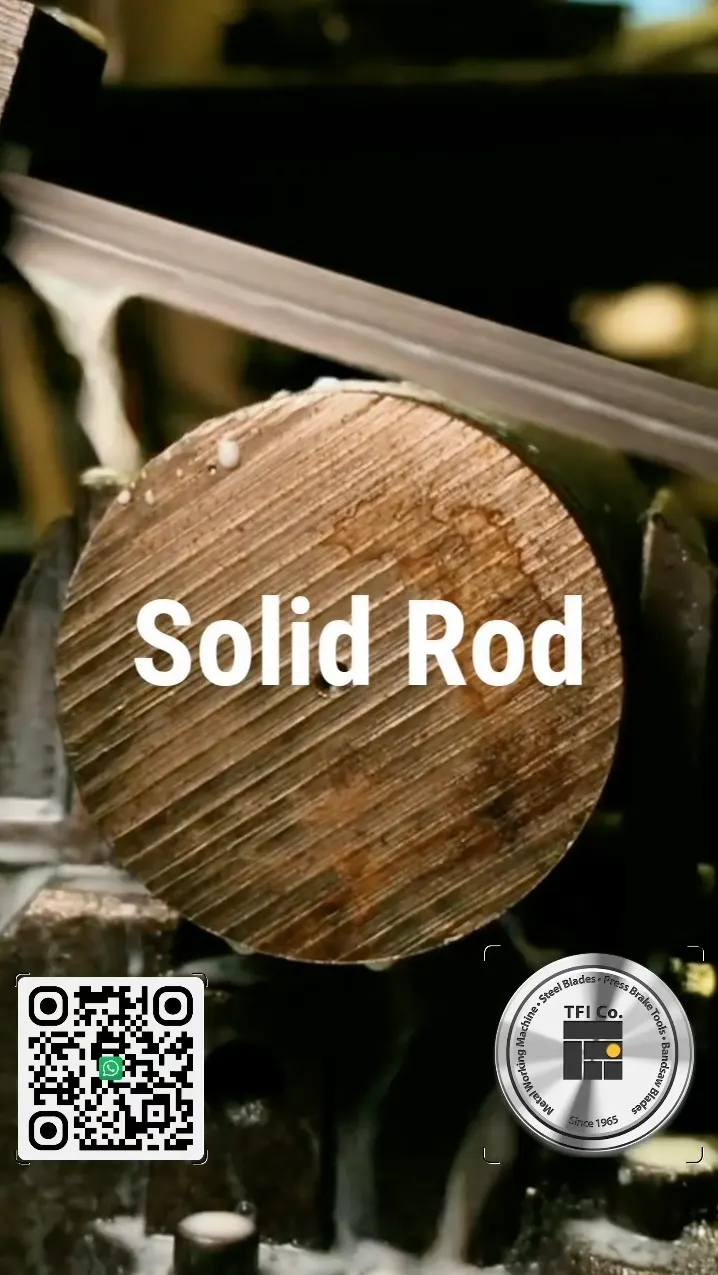
On this page9
- Where bi-metal blades are used
- Which TPI for steel bar
- Which TPI for steel round bar
- Cutting tubes, profiles and flat bar bundles
- Aluminium blocks and stainless steel pipe
- Cylinders and hard-surfaced work
- Coolant in UAE workshops
- Choosing the right blade from the M42 range
- Order bi-metal bandsaw blades online
Bi-metal bandsaw blades are the standard tool for production sawing in UAE fabrication shops, steel stockholders and maintenance workshops. This page walks through the jobs TFI Co. M42 blades are used for, from hydraulic cylinders and bundled round bar to square tube, flat bar, aluminium block and stainless steel pipe, and explains how to choose the tooth pitch (TPI) for each one.
Where bi-metal blades are used
A bi-metal blade welds a strip of M42 high-speed steel onto a flexible spring-steel back. The back survives millions of flexing cycles around the wheels; the HSS teeth keep their edge at metal-cutting heat.
That is why most horizontal and vertical metal-cutting bandsaws in the region run bi-metal as standard. TFI Co. has supplied the UAE and GCC since 1965; these are the applications customers ask about most.
| Application | Typical work | What drives blade choice |
|---|---|---|
| Cylinder cutting | Hydraulic cylinder tube and piston rod, often chrome plated | Hard surface layer, need for a square, burr-free cut |
| Round solid bar bundles | Bundles of bright or black round bar for machining stock | Diameter of each bar, stability of the bundle |
| Square and rectangular tube | Structural hollow sections, furniture and gate tube | Wall thickness, tooth stripping on thin walls |
| Flat bar bundles | Stacked flat bar for brackets, base plates and fabrication | Stack height, vibration between layers |
| Aluminium blocks | Plate and billet for machining | Chip volume and gullet capacity |
| Stainless steel pipe | Process and food-grade pipe, handrail tube | Work hardening, heat at the tooth tip |
Cylinder cutting
- Typical work
- Hydraulic cylinder tube and piston rod, often chrome plated
- What drives blade choice
- Hard surface layer, need for a square, burr-free cut
Round solid bar bundles
- Typical work
- Bundles of bright or black round bar for machining stock
- What drives blade choice
- Diameter of each bar, stability of the bundle
Square and rectangular tube
- Typical work
- Structural hollow sections, furniture and gate tube
- What drives blade choice
- Wall thickness, tooth stripping on thin walls
Flat bar bundles
- Typical work
- Stacked flat bar for brackets, base plates and fabrication
- What drives blade choice
- Stack height, vibration between layers
Aluminium blocks
- Typical work
- Plate and billet for machining
- What drives blade choice
- Chip volume and gullet capacity
Stainless steel pipe
- Typical work
- Process and food-grade pipe, handrail tube
- What drives blade choice
- Work hardening, heat at the tooth tip
Which TPI for steel bar
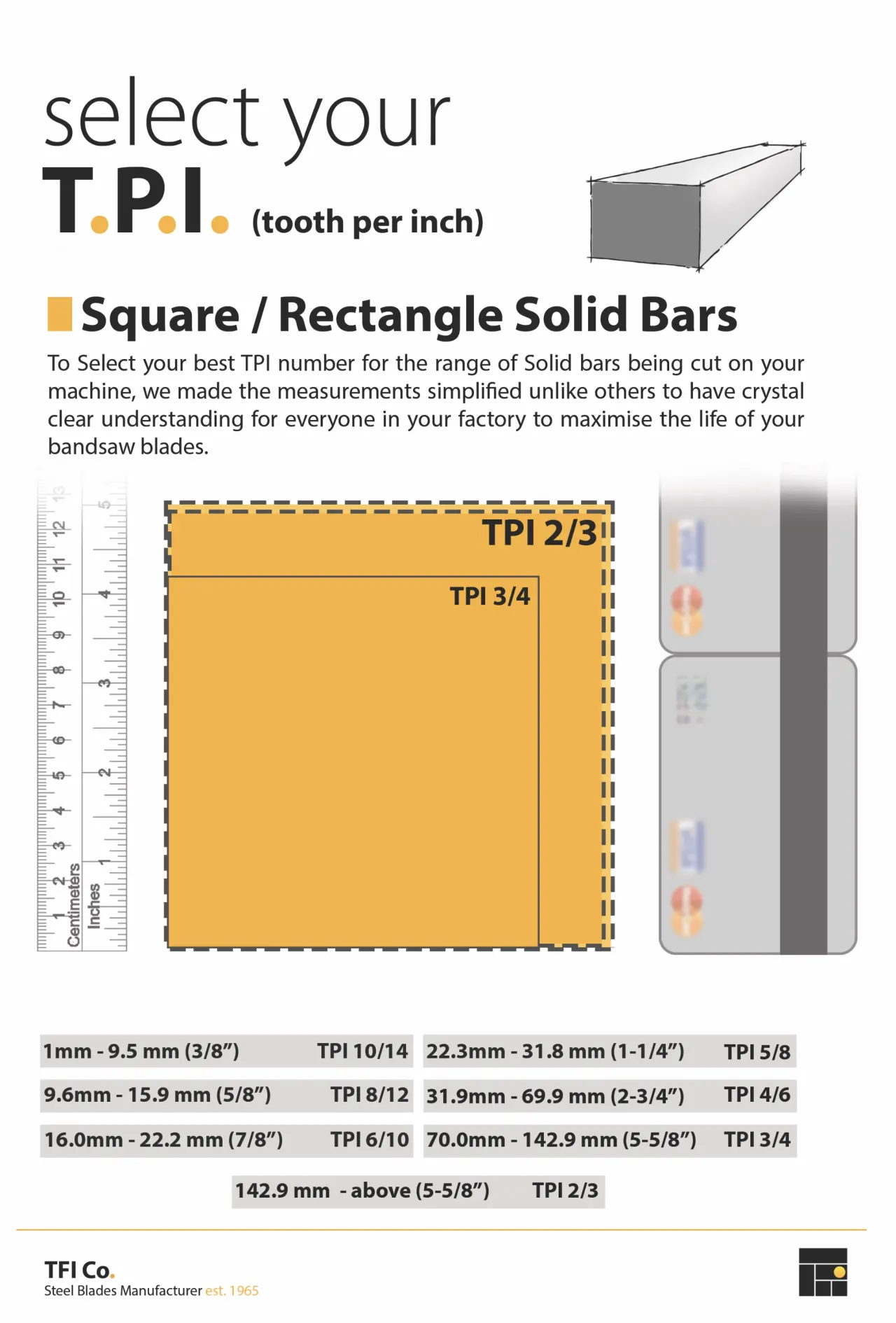
TPI (teeth per inch) is the most important choice when ordering. Too few teeth in the cut and each takes too large a bite, causing vibration and stripped teeth. Too many and the gullets choke, so the blade rubs, overheats and wanders.
Size the pitch by the length of material actually in the cut, not the outside size. A flat bar on edge presents its width; laid flat, its thickness. The usual working guide:
| Cut length through solid | Suggested variable pitch |
|---|---|
| Up to 10 mm | 10/14 or 14/18 TPI |
| 10 to 30 mm | 6/10 or 8/12 TPI |
| 30 to 60 mm | 5/8 or 4/6 TPI |
| 60 to 120 mm | 3/4 TPI |
| 120 to 250 mm | 2/3 TPI |
| Over 250 mm | 1.4/2 or coarser |
Up to 10 mm
- Suggested variable pitch
- 10/14 or 14/18 TPI
10 to 30 mm
- Suggested variable pitch
- 6/10 or 8/12 TPI
30 to 60 mm
- Suggested variable pitch
- 5/8 or 4/6 TPI
60 to 120 mm
- Suggested variable pitch
- 3/4 TPI
120 to 250 mm
- Suggested variable pitch
- 2/3 TPI
Over 250 mm
- Suggested variable pitch
- 1.4/2 or coarser
Which TPI for steel round bar
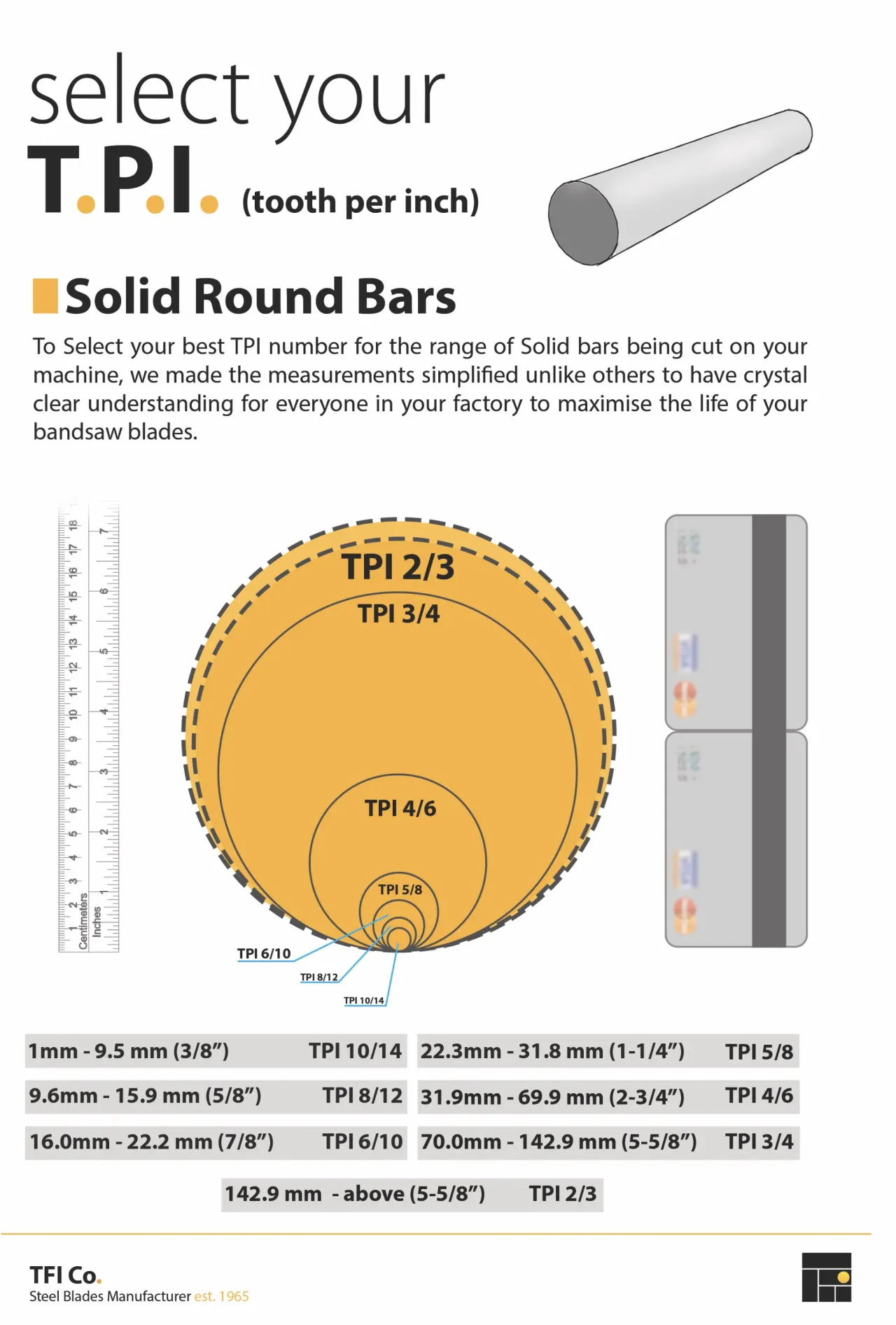
Round bar is harder on the blade than square because the cut length changes continuously: few teeth engage at entry and exit, the full diameter through the centre. Variable pitch breaks up the vibration that constant pitch sets up.
- Choose the pitch for the full diameter using the table above.
- Clamp the bar firmly; any rotation in the vice snaps teeth at entry.
- Reduce feed slightly at entry and exit, where few teeth carry the load.
Cutting round bar in bundles
- Clamp the bundle tightly so bars cannot roll; loose or mixed-diameter bundles are a common cause of early tooth loss.
- Start from the pitch for a single bar, then go one step coarser (for example 6/10 to 5/8 TPI) so gullets carry chips across the full width.
- Use variable pitch to cope with repeated entry and exit as teeth cross from bar to bar.
Cutting tubes, profiles and flat bar bundles
Tube and pipe are thin-walled, so the danger is too coarse a pitch. Keep at least two, preferably three, teeth in the wall at all times and choose by wall thickness:
| Wall thickness | Suggested pitch |
|---|---|
| Under 2 mm | 14/18 TPI |
| 2 to 4 mm | 10/14 TPI |
| 4 to 6 mm | 8/12 or 6/10 TPI |
| 6 to 10 mm | 5/8 TPI |
| Over 10 mm | 4/6 TPI |
Under 2 mm
- Suggested pitch
- 14/18 TPI
2 to 4 mm
- Suggested pitch
- 10/14 TPI
4 to 6 mm
- Suggested pitch
- 8/12 or 6/10 TPI
6 to 10 mm
- Suggested pitch
- 5/8 TPI
Over 10 mm
- Suggested pitch
- 4/6 TPI
- Tube bundles and deep sections: step one pitch coarser so gullets carry chips across the work.
- Flat bar stacks: behave like a series of thin sections; clamp vertically as well as horizontally to stop layers chattering, and use variable pitch.
- Beams and channels: interrupted cuts through flanges and web favour a variable pitch such as 3/4 or 4/6 TPI with a strong tooth.
Aluminium blocks and stainless steel pipe
Aluminium blocks
Aluminium produces large volumes of soft, sticky chips that can weld into the gullets. Use a coarser pitch than for steel of the same size, a positive rake, high blade speed, good lubrication and a clean chip brush.
Stainless steel pipe
Austenitic stainless work-hardens when a tooth rubs. Keep the feed positive so every tooth takes a real chip, run slower than mild steel (roughly 20 to 35 m/min) with plenty of coolant. A positive rake such as the Yazd tooth form in our M42 range helps the tooth bite.
Cylinders and hard-surfaced work
Hydraulic cylinder rods are often chrome plated and induction hardened on the surface while the core stays relatively soft. The hard skin, and the switch from skin to core, is what chips teeth.
- Clamp the rod firmly so it cannot turn.
- Start at reduced feed until the teeth are through the surface layer.
- Increase to normal feed in the soft core and keep it steady.
For heavy production of hardened rod, carbide-tipped blades are the usual industry answer; for occasional work, a heat-resistant HSS tooth with a special relief angle can be enough. Ask us to compare options.
Coolant in UAE workshops
Coolant removes heat, lubricates the tooth and flushes chips; without it, even the right blade loses its edge quickly. In UAE heat, water evaporates fast, so check concentration often.
| Material | Coolant practice |
|---|---|
| Mild and structural steel | Standard soluble-oil mix, typically around 8 to 12% concentrate |
| Stainless and tough alloys | Richer mix and generous flow at the tooth |
| Aluminium | Lubricant or mist to stop chips welding to the teeth |
| All materials | Top up with pre-mixed coolant, not plain water, to replace evaporation and chip carry-out |
Mild and structural steel
- Coolant practice
- Standard soluble-oil mix, typically around 8 to 12% concentrate
Stainless and tough alloys
- Coolant practice
- Richer mix and generous flow at the tooth
Aluminium
- Coolant practice
- Lubricant or mist to stop chips welding to the teeth
All materials
- Coolant practice
- Top up with pre-mixed coolant, not plain water, to replace evaporation and chip carry-out
Choosing the right blade from the M42 range
The M42 bi-metal range covers general mild steel, structural and stainless steel, and more difficult alloys, in the common widths for workshop and production bandsaws. Models, sizes and tooth hardness are in the M42 bi-metal bandsaw blade catalogue.
Unsure which model or pitch suits your work? Tell us the material, section size and machine model and we will recommend a specification.
Can one blade cut both solid bar and tube?
Yes, within limits. A variable pitch such as 6/10 or 5/8 TPI covers a useful range of medium bar and heavier-walled tube. If your work mixes thin-wall tube with large solids, two blades will give better results and longer life than one compromise blade.
Why do my teeth strip when cutting square tube?
The pitch is usually too coarse for the wall thickness, so fewer than two teeth are in the wall and each one catches on the edge. Change to a finer pitch and check that the tube is clamped firmly.
Is a bi-metal blade suitable for aluminium?
Yes. Bi-metal blades cut aluminium well when the pitch is coarse enough to clear the chips and the blade speed is high. Use a lubricant to prevent chips sticking to the teeth.
What TPI should I use for a 50 mm steel round bar?
A 4/6 or 5/8 TPI variable pitch is the normal starting point for a 50 mm solid bar in mild or alloy steel. A heavier machine running a wide blade can use the coarser end of that range.
How do I order the right blade?
Send us the material, section sizes, your machine model and the blade dimensions. The guide to ordering TFI Co. bandsaw blades lists everything we need.
Order bi-metal bandsaw blades online
Tell us the blade width x thickness, the length of each welded blade, the TPI if you know it, the material and section sizes you cut, the quantity, and the emirate for delivery. We confirm the specification before quoting, and production shops on a regular blade schedule get good prices on bulk orders.
This page details bi metal bandsaw blades applications in the UAE for cylinder cutting, circular solid rod bundles, square tubes, rectangular tubes, flat bar bundles, aluminium blocks, stainless steel pipes and many more metalworking tasks, helping procurement teams and fabrication workshops select the correct M42 tooth pitch and TPI for each material. Readers gain clear guidance on blade specification to achieve precise, efficient cuts while solving common selection problems that affect productivity and blade life in both metalworking and food-industry bandsaw operations. As Manufacturer of Steel Blades Since 1965, TFI Co. structures this practical catalogue content to support direct quotation and ordering enquiries across the UAE and GCC.
Need to Know
Specification Table
| Product Type | Bi Metal Bandsaw Blades |
|---|---|
| Material Grade | M42 |
| Manufacturer | Manufacturer of Steel Blades Since 1965 |
| Supplier | TFI Co |
| Primary Applications | Cylinder cutting, circular solid rods bundle, square tubes, rectangular tube, flat bars bundle, aluminum blocks, stainless steel pipes |
| Tooth Pitch | Specify on order |
| Blade Sizes | Specify on order |
| TPI for Steel Bar | Specify on order |
| TPI for Steel Round Bar | Specify on order |
| Compatible With | Metal cutting bandsaw blades and cutting applications |
| Target Markets | UAE, GCC |
| Catalogue Reference | M42 Bi Metal Catalogue |
| Ordering Method | Enquiry-based ordering for industrial use |
- Product Type
- Bi Metal Bandsaw Blades
- Material Grade
- M42
- Manufacturer
- Manufacturer of Steel Blades Since 1965
- Supplier
- TFI Co
- Primary Applications
- Cylinder cutting, circular solid rods bundle, square tubes, rectangular tube, flat bars bundle, aluminum blocks, stainless steel pipes
- Tooth Pitch
- Specify on order
- Blade Sizes
- Specify on order
- TPI for Steel Bar
- Specify on order
- TPI for Steel Round Bar
- Specify on order
- Compatible With
- Metal cutting bandsaw blades and cutting applications
- Target Markets
- UAE, GCC
- Catalogue Reference
- M42 Bi Metal Catalogue
- Ordering Method
- Enquiry-based ordering for industrial use
Suitable Industries
- Cylinder Cutting TFI Co. bi-metal bandsaw blades deliver precise cylinder cutting in metalworking factories across the UAE with correct tooth pitch selection as Manufacturer of Steel Blades Since 1965.
- Circular Solid Rods Maintenance teams in GCC fabrication workshops apply M42 bi-metal bandsaw blades for bundle cutting of circular solid rods determining optimal TPI for steel round bar.
- Square Tube Fabrication Fabrication workshops utilise metal cutting bandsaw blades in appropriate sizes and tooth pitches for square tube processing in UAE industrial environments.
- Rectangular Tube Cutting Procurement departments source bi-metal bandsaw blades for rectangular tube cutting applications within export-oriented industrial markets in the GCC.
- Flat Bars Bundle Metalworking factories employ bi metal bandsaw blades with specified tooth pitch for flat bars bundle cutting to maintain production efficiency in the UAE.
- Aluminum Block Processing Maintenance teams select suitable bandsaw blade sizes and pitches for aluminum blocks cutting using M42 bi-metal blades in GCC fabrication facilities.
- Stainless Steel Pipes Industrial procurement departments in the UAE procure TFI Co. metal cutting bandsaw blades for stainless steel pipes applications requiring precise TPI as Manufacturer of Steel Blades Since 1965.
- Steel Bar Applications UAE maintenance teams reference tooth pitch guidelines to select bi-metal bandsaw blades for steel bar and round bar cutting in high-volume workshops.
Common Questions
What are the primary applications of bi-metal bandsaw blades from TFI Co. in the UAE?
Bi-metal bandsaw blades from TFI Co., Manufacturer of Steel Blades Since 1965, are applied in cylinder cutting, circular solid rods bundles, square tubes, rectangular tubes, flat bars bundles, aluminum blocks, stainless steel pipes, and many more. These solutions support precise metalworking and fabrication requirements across UAE and GCC industries with reliable performance.
How does TFI Co. support TPI selection for steel bar cutting?
TFI Co. addresses key questions such as which TPI for steel bar and which TPI for steel round bar. Guidance considers material type, cross-section dimensions, and machine parameters to recommend optimal tooth pitches, ensuring maximum cutting efficiency, minimal vibration, and extended blade life in UAE industrial applications.
Can bi-metal bandsaw blades effectively cut both aluminum blocks and stainless steel pipes?
Yes, bi-metal bandsaw blades from TFI Co. are engineered to cut aluminum blocks and stainless steel pipes with precision. Their construction handles the distinct machining properties of each material, delivering clean edges and consistent performance for fabrication workshops and maintenance teams throughout the UAE.
Does the post cover bundle cutting applications for bi-metal bandsaw blades?
The post details bundle cutting operations including circular solid rods bundles and flat bars bundles. TFI Co. highlights how these bi-metal blades maintain stability and accuracy on bundled sections, delivering productivity benefits for steel service centres and metalworking factories in the UAE and GCC.
Which tube profiles can be processed with TFI Co. bi-metal bandsaw blades?
TFI Co. bi-metal bandsaw blades are suitable for square tubes, rectangular tubes, and stainless steel pipes. These blades provide straight, high-quality cuts on hollow profiles, meeting technical demands of industrial procurement departments and fabrication facilities operating across the UAE market.
How can I request a quote for bi-metal bandsaw blades for stainless steel pipes in the UAE?
For bi-metal bandsaw blades suited to stainless steel pipes or aluminum blocks cutting in the UAE, contact via Chat for the fastest response. Submit requirements through the online form or call our team. TFI Co., Manufacturer of Steel Blades Since 1965, delivers specification-focused support for your exact application.
- Section
- M42 Bi-Metal Bandsaw Blade Catalogue: BAM, Yazd, Qom and Kish
- Updated
- October 7, 2026
- Reading time
- 11 min read
Order or plan your blade supply
We appreciate scheduled orders, favour planned blade maintenance and offer good prices for bulk orders. Tell us what you need and our team replies by email.
Send an enquiry