
On this page10
- Anatomy of a bandsaw blade
- Blade materials: carbon, bi-metal, M42, M51 and carbide
- Tooth forms and tooth pitch
- Three tooth forms for metal cutting
- Tooth set patterns
- Blade sizing: width, thickness and length
- Choosing the correct blade for your material
- Breaking in a new blade
- Why bandsaw blades fail
- Order bandsaw blades online
A bandsaw blade looks simple, but its back, teeth, set and pitch each decide how fast it cuts, how straight it runs and how long it lasts. This guide explains how a metal-cutting blade is built, the main blade materials, tooth forms and set patterns, how to choose TPI and size, and why blades fail, so buyers in the UAE and GCC can specify the right blade first time.
Anatomy of a bandsaw blade
Every metal-cutting band has the same basic parts. Knowing the terms makes ordering and troubleshooting far easier.
| Part | What it does |
|---|---|
| Back (backer) | Body of the band; flexes around the wheels and carries the feed force |
| Width | Tooth tip to back edge; wider blades resist deflection and cut straighter |
| Thickness (gauge) | Thicker bands are stiffer but need larger wheels to avoid fatigue cracks |
| Tooth tip and rake face | Cutting edge, and the face that pushes the chip away; rake can be 0 degree or positive |
| Gullet | Curved space between teeth that carries chips out of the cut; its depth limits chip load |
| Set | Sideways bend of the teeth that makes the kerf wider than the back, so the blade does not bind |
| Weld | Joint that turns a cut length of band into a continuous loop |
Back (backer)
- What it does
- Body of the band; flexes around the wheels and carries the feed force
Width
- What it does
- Tooth tip to back edge; wider blades resist deflection and cut straighter
Thickness (gauge)
- What it does
- Thicker bands are stiffer but need larger wheels to avoid fatigue cracks
Tooth tip and rake face
- What it does
- Cutting edge, and the face that pushes the chip away; rake can be 0 degree or positive
Gullet
- What it does
- Curved space between teeth that carries chips out of the cut; its depth limits chip load
Set
- What it does
- Sideways bend of the teeth that makes the kerf wider than the back, so the blade does not bind
Weld
- What it does
- Joint that turns a cut length of band into a continuous loop
Blade materials: carbon, bi-metal, M42, M51 and carbide
The material of the teeth decides which metals a blade can cut economically. The back is chosen for flexibility and fatigue life.
| Type | Construction | Typical use |
|---|---|---|
| Carbon steel | One-piece carbon steel band with hardened teeth | Light workshop use, wood, plastics, occasional mild steel, food blades |
| Bi-metal M42 | HSS tooth strip with about 8% cobalt welded to a spring-steel back | General production cutting of carbon, structural and alloy steels, stainless, tube and profiles |
| Bi-metal M51 | HSS edge with higher cobalt and tungsten content | Stainless, tool steel, titanium, nickel alloys and other heat-resistant materials |
| Carbide tipped | Carbide teeth brazed or welded to an alloy back | Hardened shafts, abrasive or very hard materials, high-volume production on rigid machines |
Carbon steel
- Construction
- One-piece carbon steel band with hardened teeth
- Typical use
- Light workshop use, wood, plastics, occasional mild steel, food blades
Bi-metal M42
- Construction
- HSS tooth strip with about 8% cobalt welded to a spring-steel back
- Typical use
- General production cutting of carbon, structural and alloy steels, stainless, tube and profiles
Bi-metal M51
- Construction
- HSS edge with higher cobalt and tungsten content
- Typical use
- Stainless, tool steel, titanium, nickel alloys and other heat-resistant materials
Carbide tipped
- Construction
- Carbide teeth brazed or welded to an alloy back
- Typical use
- Hardened shafts, abrasive or very hard materials, high-volume production on rigid machines
- M42 bi-metal is the right default for most UAE fabrication shops and stockholders: versatile, forgiving and far longer-lasting than carbon steel on metal.
- M51 earns its higher price where heat at the tooth tip limits blade life.
- Carbide lasts longer again on hard work, but needs a heavy, rigid machine with steady tension and feed, and is expensive to damage.
How our bi-metal blades are built
Our bi-metal blades combine a fatigue-resistant back with an HSS cutting edge. The main construction points are:
| Backer | Specially alloyed spring steel, approximately 50 HRC, flexible for long fatigue life on the wheels |
|---|---|
| Back treatment | Extended Life Treatment with controlled blast peening, to reduce fatigue cracks that start at microscopic grain boundaries |
| Tooth geometry | Multi-chip design for good penetration |
| Gullet | Shaped to improve chip flow |
- Backer
- Specially alloyed spring steel, approximately 50 HRC, flexible for long fatigue life on the wheels
- Back treatment
- Extended Life Treatment with controlled blast peening, to reduce fatigue cracks that start at microscopic grain boundaries
- Tooth geometry
- Multi-chip design for good penetration
- Gullet
- Shaped to improve chip flow
Tooth forms and tooth pitch
Three tooth forms for metal cutting
Form N (standard or regular)
Straight tooth, 0 degree rake, full gullet. General steel cutting and thin sections.
Form H (hook)
Positive rake that bites hard and curls the chip. Thicker sections, softer non-ferrous metals, free-cutting materials.
Form K (combination or positive variable)
Positive rake on a variable pitch. Solids, tough alloys and work-hardening materials.
Form N (standard or regular)
Straight tooth, 0 degree rake, full gullet. General steel cutting and thin sections.
Form H (hook)
Positive rake that bites hard and curls the chip. Thicker sections, softer non-ferrous metals, free-cutting materials.
Form K (combination or positive variable)
Positive rake on a variable pitch. Solids, tough alloys and work-hardening materials.
Constant pitch
All teeth are the same distance apart. The number of teeth per inch (25.4 mm) gives the pitch, for example 6 TPI. Simple and effective on uniform sections.
Variable pitch
Tooth spacing changes within a repeating group. The pitch is given as the coarsest and finest spacing, for example 5/8 TPI. Mixed spacing breaks up vibration and noise, and one blade covers a wider range of sizes.
Choosing TPI
The working rule is to keep at least three teeth in the material at all times, with six to twelve ideal on solids. Too coarse and teeth strip on thin walls; too fine and the gullets choke, the blade overheats and the cut wanders. Choose by the length of cut through solid stock, or by wall thickness for tube and profile:
| Solid section | Variable pitch | Tube wall thickness | Variable pitch |
|---|---|---|---|
| Up to 10 mm | 10/14 or 14/18 | Under 2 mm | 14/18 |
| 10 to 30 mm | 6/10 or 8/12 | 2 to 4 mm | 10/14 |
| 30 to 60 mm | 5/8 or 4/6 | 4 to 6 mm | 6/10 or 8/12 |
| 60 to 120 mm | 3/4 | 6 to 10 mm | 5/8 |
| Over 120 mm | 2/3 or coarser | Over 10 mm | 4/6 |
Up to 10 mm
- Variable pitch
- 10/14 or 14/18
- Tube wall thickness
- Under 2 mm
- Variable pitch
- 14/18
10 to 30 mm
- Variable pitch
- 6/10 or 8/12
- Tube wall thickness
- 2 to 4 mm
- Variable pitch
- 10/14
30 to 60 mm
- Variable pitch
- 5/8 or 4/6
- Tube wall thickness
- 4 to 6 mm
- Variable pitch
- 6/10 or 8/12
60 to 120 mm
- Variable pitch
- 3/4
- Tube wall thickness
- 6 to 10 mm
- Variable pitch
- 5/8
Over 120 mm
- Variable pitch
- 2/3 or coarser
- Tube wall thickness
- Over 10 mm
- Variable pitch
- 4/6
For bundles, start from the pitch that suits a single piece and step one size coarser. Machine size, blade width and the grade of steel can move the choice one step either way.
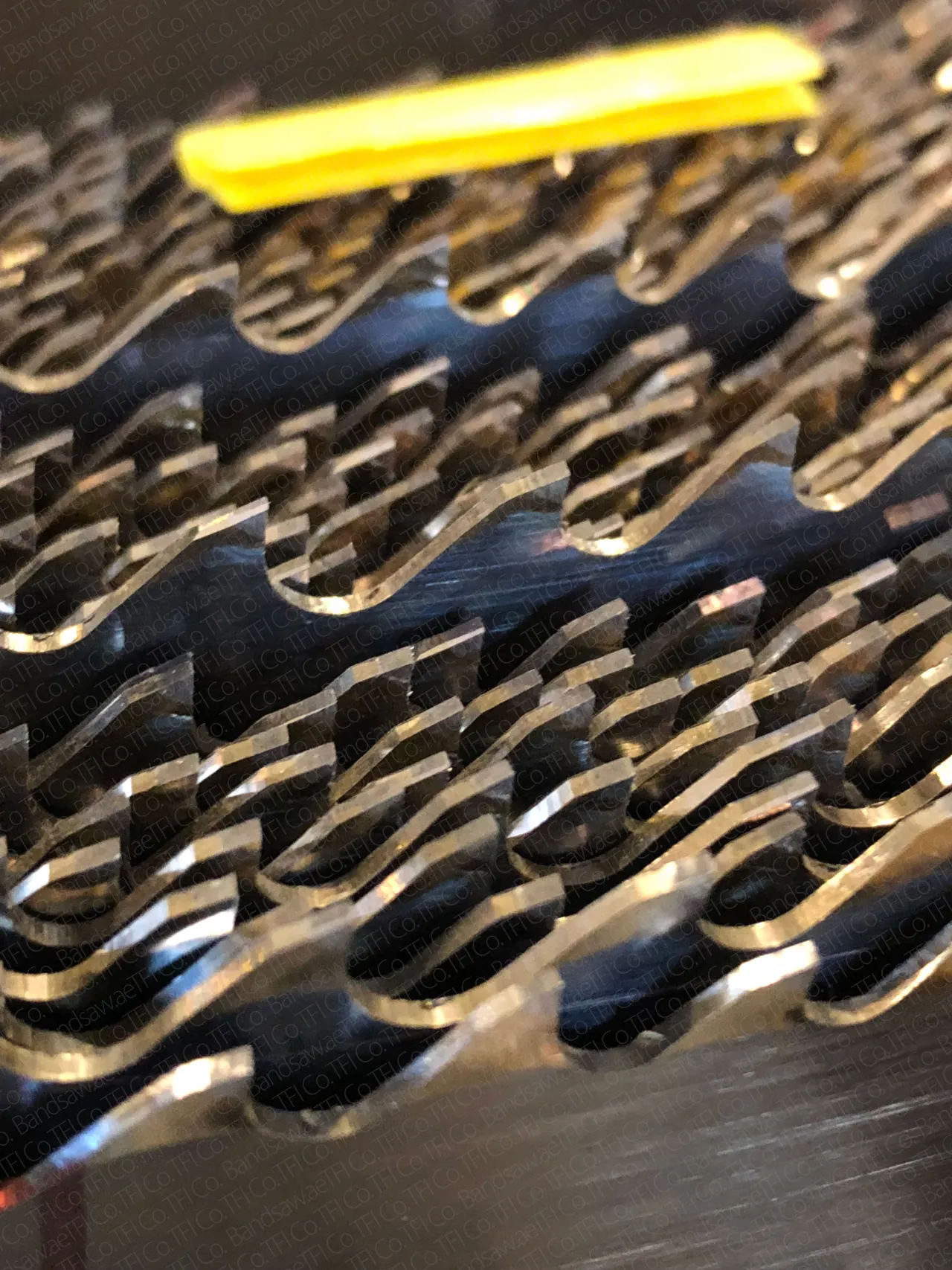
Tooth set patterns
The set gives the back of the blade clearance in the kerf, which prevents pinching in difficult cuts. Width and type of set are matched to the job.
| Set | Pattern | Used with |
|---|---|---|
| Raker | Repeating left, right, straight teeth | Forms N and H, pitches up to 10 TPI |
| Variable group | Set angles vary across a tooth group to match variable pitch | Form K, 0.75/1.25 to 10/14 TPI |
| Wavy | Groups of teeth set progressively left and right in a wave | Form N, 14 to 32 TPI; thin tube and sheet |
Raker
- Pattern
- Repeating left, right, straight teeth
- Used with
- Forms N and H, pitches up to 10 TPI
Variable group
- Pattern
- Set angles vary across a tooth group to match variable pitch
- Used with
- Form K, 0.75/1.25 to 10/14 TPI
Wavy
- Pattern
- Groups of teeth set progressively left and right in a wave
- Used with
- Form N, 14 to 32 TPI; thin tube and sheet
Blade sizing: width, thickness and length
Width and thickness are fixed by the machine: guides, wheel diameter and tensioning system are designed for one band size. The length is the circumference of the welded loop and must match the machine exactly.
| Typical bi-metal sizes | 27 x 0.9 mm, 34 x 1.1 mm, 41 x 1.3 mm, from small workshop saws to heavy production machines |
|---|---|
| Thickness vs wheel | Bending stress rises with thickness divided by wheel diameter; a band too thick for its wheels cracks early |
| Tension | Bi-metal and carbide bands run at high tension, commonly 25,000 to 30,000 psi; machine scales are often inaccurate, so a tension meter is worth using |
| Fastest way to specify | Read the size printed on the back of the current blade, or send us the machine make and model |
- Typical bi-metal sizes
- 27 x 0.9 mm, 34 x 1.1 mm, 41 x 1.3 mm, from small workshop saws to heavy production machines
- Thickness vs wheel
- Bending stress rises with thickness divided by wheel diameter; a band too thick for its wheels cracks early
- Tension
- Bi-metal and carbide bands run at high tension, commonly 25,000 to 30,000 psi; machine scales are often inaccurate, so a tension meter is worth using
- Fastest way to specify
- Read the size printed on the back of the current blade, or send us the machine make and model
Choosing the correct blade for your material
We select blades to suit the material and shape you cut, including:
- Aluminium and copper alloys
- Tubes, profiles and thick-walled tubing
- Carbon steel round, square and flat bar
- Alloy steels and cast iron
- Single-layer and multi-layer bundles
- Angles, I-beams and H-beams
TFI Co. has been producing saws since 1965 and makes bandsaw blades in-house, so blade characteristics can be matched to your machine as well as your material.
Breaking in a new blade
New teeth are extremely sharp but fragile at the very tip. Break-in hones that edge slightly so it withstands full load, which prevents early chipping, extends blade life and improves the cut finish.
- Set the normal blade speed for the material.
- Reduce the feed rate by 20% to 50%, depending on machinability. Softer materials need the larger reduction.
- If noise or vibration appears, make small adjustments to speed or feed.
- Increase the feed gradually over the following cuts until the normal cutting rate is reached.
Why bandsaw blades fail
Most short blade lives come from a small number of causes. Rather than waiting for a breakage mid-shift, we favour planned maintenance: replace blades on a schedule set by cutting hours, number of cuts or regular wear checks, and we can help you set that plan up.
| Symptom | Likely causes |
|---|---|
| Stripped teeth | Pitch too coarse, no break-in, feed too high, work moving in the vice, blade speed too low |
| Crooked cut | Pitch too fine and gullets choked, worn teeth, low tension, guides set too far from the work |
| Rapid dulling | Blade speed too high, feed too light (rubbing), poor coolant, hard scale |
| Cracks in the back | Worn back guide, excessive tension, wheels too small for the gauge |
| Breaking at the weld | Poor weld or annealing, guides too tight, blade not de-tensioned when idle |
Stripped teeth
- Likely causes
- Pitch too coarse, no break-in, feed too high, work moving in the vice, blade speed too low
Crooked cut
- Likely causes
- Pitch too fine and gullets choked, worn teeth, low tension, guides set too far from the work
Rapid dulling
- Likely causes
- Blade speed too high, feed too light (rubbing), poor coolant, hard scale
Cracks in the back
- Likely causes
- Worn back guide, excessive tension, wheels too small for the gauge
Breaking at the weld
- Likely causes
- Poor weld or annealing, guides too tight, blade not de-tensioned when idle
Is M42 or M51 better for my workshop?
M42 suits most steels, tube and profiles. Choose M51 where you cut a lot of stainless, tool steel, titanium or nickel alloys and heat at the tooth tip is wearing out M42 blades too quickly.
When should I use a carbide-tipped blade?
For hardened shafts, very abrasive materials or very high production volumes, on a rigid machine that holds steady tension and feed. For general fabrication, bi-metal is more economical.
How do I know which TPI I need?
Make sure at least three teeth are in the material. Use the tables above as a starting point, or tell us the material and section and we will recommend a pitch.
What information do you need to supply a blade?
Width x thickness, length, TPI, material and quantity. The guide to ordering TFI Co. bandsaw blades lists the details.
Why does a new blade need break-in?
Fresh tooth tips are very sharp and fragile. Cutting at reduced feed for the first cuts hones them so they survive full load, which noticeably extends blade life.
Order bandsaw blades online
Send us the blade width x thickness, the welded length or coil metres, the TPI, the material and section sizes you cut, the quantity, and your delivery emirate. If you are unsure of any detail, include your machine model. Scheduled orders that match your replacement plan are welcome, and bulk quantities get good prices.
- Updated
- October 7, 2026
- Reading time
- 7 min read
Order or plan your blade supply
We appreciate scheduled orders, favour planned blade maintenance and offer good prices for bulk orders. Tell us what you need and our team replies by email.
Send an enquiry