

On this page10
Kish is the blade in the TFI Co. M42 bi-metal catalogue built for one hard job: cutting tubes and profiles without losing teeth. Its dedicated tooth design resists the breakage and stripping that interrupted cuts cause, so it can take heavy penetration at fast cutting rates on tubes, roll-formed sections, bent profiles and structural steel.

Kish blade overview
| Catalogue | TFI Co. M42 bi-metal range |
|---|---|
| Tooth form | Dedicated tube-cutting teeth with a protective feature on the back face of the tooth tip |
| Main benefit | Resists tooth breakage, stripping and continuous chipping on interrupted cuts |
| Widths x gauge | 27 x 0.9, 34 x 1.1, 41 x 1.27 mm |
| Pitch | 4/6 TPI variable |
| Coil length | 250 ft (about 76 m) |
| Best suited to | Tubes, roll-formed and bent profiles, structural steel, small bundles |
- Catalogue
- TFI Co. M42 bi-metal range
- Tooth form
- Dedicated tube-cutting teeth with a protective feature on the back face of the tooth tip
- Main benefit
- Resists tooth breakage, stripping and continuous chipping on interrupted cuts
- Widths x gauge
- 27 x 0.9, 34 x 1.1, 41 x 1.27 mm
- Pitch
- 4/6 TPI variable
- Coil length
- 250 ft (about 76 m)
- Best suited to
- Tubes, roll-formed and bent profiles, structural steel, small bundles
Tube is often the cheapest material on the rack and the most expensive to cut, measured in blades. Kish gives each tooth the support to survive thousands of entries and exits. Signs a shop needs it:
- Teeth missing after short runs on tube
- A ragged cut where the blade exits each wall
- A band that rings loudly through a bundle
All three point to impact and vibration rather than wear.
Construction and tooth geometry
A tooth cutting solid bar enters once and stays engaged. In a tube it meets a cycle of impacts:
- It strikes the top wall and breaks through into empty space.
- It strikes the side walls, cutting only the wall thickness.
- It strikes the bottom wall and exits again.
In a bundle those impacts multiply across every piece, and loose tubes add vibration. A tooth that catches a wall edge under vibration snaps or is stripped from the band.
The Kish tooth is shaped for that cycle. A feature on the back face of the tip limits how deeply each tooth bites at impact, suppressing over-cutting and the continuous chipping that follows. With the tip protected, the blade can be fed harder for heavy penetration without the usual stripped teeth.
The 4/6 TPI variable pitch completes the design: irregular spacing stops the band settling into a resonant frequency, which is what turns vibration into broken teeth on thin walls.

Sizes, pitch and part numbers
Kish coil strips, 4/6 TPI variable pitch, 250 ft coils
27.0 x 0.90 mm (1 x .035 in)
4/6 TPI variable pitch, 250 ft coil. For small and medium bandsaw machines.
Code TFI280
34.0 x 1.10 mm (1-1/4 x .042 in)
4/6 TPI variable pitch, 250 ft coil. For medium production saws cutting larger bundles.
Code TFI281
41.0 x 1.27 mm (1-1/2 x .050 in)
4/6 TPI variable pitch, 250 ft coil. For heavy-duty saws and large profile bundles.
Code TFI282

Kish is supplied as coil for welding to your machine length. Tube lines use blades steadily, so we appreciate scheduled orders on a regular call-off, and bulk coil orders are priced favourably.
What Kish cuts best
Kish is the blade for any work where the teeth keep entering and leaving the material:
- Round, square and rectangular tubes, singly or in bundles
- Roll-formed profiles, including roll-formed tube
- Bundles of bent profiles
- Channel and other structural steel sections that vibrate in the vice
- Small bundles of mixed light sections
It is less suited to large solid bar, where the 4/6 pitch is too fine for the chip volume. Move solids to Yazd, and stainless or nickel-alloy tube to a positive-rake model suited to that material.
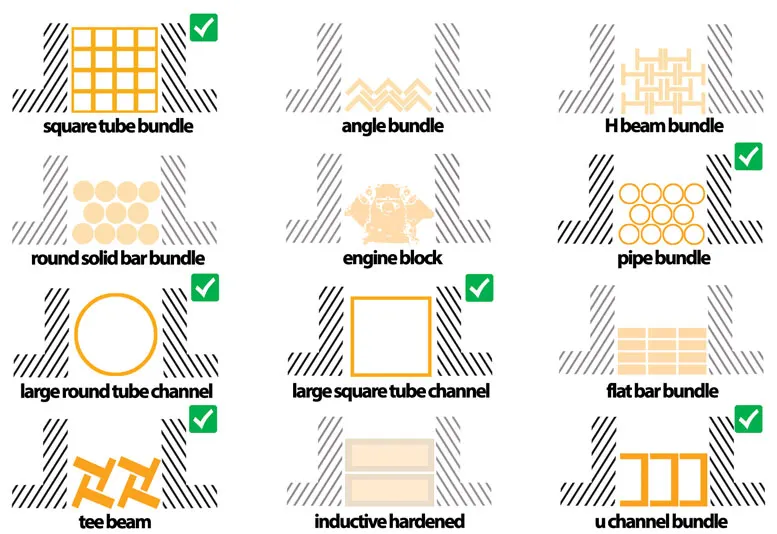
TPI and wall thickness
Kish comes in a single 4/6 TPI variable pitch, which covers the walls and bundle sizes most common in fabrication. Judge a job by the wall, not the outside diameter, and aim for at least three teeth on the wall, ideally six to twelve.
| Job | Kish 4/6 fit | Better option if not |
|---|---|---|
| Tube and profile bundles | Good: several walls are cut at once, lengthening the effective cut | Not needed |
| Structural sections, channel, roll-formed profiles | Good: variable pitch damps vibration as engagement changes | Not needed |
| Very thin-wall tube cut singly | Limited: tooth spacing of about 4 to 6 mm may leave too few teeth on the wall | BAM in 10/14 or 14 wavy |
| Heavy-wall pipe that behaves like a solid | Limited: gullets too small for the chip | Yazd in a coarse pitch |
Tube and profile bundles
- Kish 4/6 fit
- Good: several walls are cut at once, lengthening the effective cut
- Better option if not
- Not needed
Structural sections, channel, roll-formed profiles
- Kish 4/6 fit
- Good: variable pitch damps vibration as engagement changes
- Better option if not
- Not needed
Very thin-wall tube cut singly
- Kish 4/6 fit
- Limited: tooth spacing of about 4 to 6 mm may leave too few teeth on the wall
- Better option if not
- BAM in 10/14 or 14 wavy
Heavy-wall pipe that behaves like a solid
- Kish 4/6 fit
- Limited: gullets too small for the chip
- Better option if not
- Yazd in a coarse pitch
Break-in and running tips
New Kish teeth should be honed before they meet a bundle, because wall impacts chip fresh tips:
- Run the first cuts on a solid mild-steel section at about half normal feed.
- Keep that up for ten to fifteen minutes of cutting.
- Step the feed up, then move to tube.
- Speed and feed: keep band speed suited to the material and use feed to control the load at wall entry.
- Coolant: flushes chips from inside the tubes and out of the gullets. TFI Co. supplies coolant liquid for bandsaw machines.
- Bundles: expect shorter band life than on single pieces, since every tube means two walls entered and left. Stack so vice pressure spreads across the full width, and use a top clamp where the saw has one.
- Blade angle: a canted head lets the band meet walls at a slight angle, improving the cut and blade life.
- Inspect after the first shift: teeth missing in a regular pattern point to vibration or loose clamping, not the blade.
We favour planned maintenance for tube lines: swap Kish bands on a schedule of cuts or wear checks before stripping starts. We can help set the schedule.
Kish compared with the other M42 blades
| Model | Tooth design | Pitches | Choose it for |
|---|---|---|---|
| Kish (this blade) | Dedicated tube-cutting teeth | 4/6 | Tubes, profiles and vibration-prone structurals |
| BAM | Straight teeth, 0° rake | 3/4 to 14 wavy | Mild steel general work and very thin walls with 14 TPI wavy |
| Yazd | Strengthened teeth, positive rake | 2/3 to 8 raker | Thick-wall tube, solids and stainless |
| Qom | Engineered relief angle | 2/3 to 4/6 | Nickel alloys, titanium and copper alloys |
Kish (this blade)
- Tooth design
- Dedicated tube-cutting teeth
- Pitches
- 4/6
- Choose it for
- Tubes, profiles and vibration-prone structurals
- Tooth design
- Straight teeth, 0° rake
- Pitches
- 3/4 to 14 wavy
- Choose it for
- Mild steel general work and very thin walls with 14 TPI wavy
- Tooth design
- Strengthened teeth, positive rake
- Pitches
- 2/3 to 8 raker
- Choose it for
- Thick-wall tube, solids and stainless
- Tooth design
- Engineered relief angle
- Pitches
- 2/3 to 4/6
- Choose it for
- Nickel alloys, titanium and copper alloys
Compare every model in the M42 bi-metal blade catalogue.
Kish blade questions
Why do my blades lose teeth when cutting tube?
Each tooth hits the tube wall, breaks through and hits again, and bundles vibrate. These repeated impacts strip teeth from standard blades. Kish is designed to limit the bite at impact and resist that damage.
Can Kish cut solid bar?
It can cut small solids, but its 4/6 pitch is too fine for large bars. Use Yazd or BAM in a coarse pitch for solids.
Is Kish only for round tube?
No. It is designed for square and rectangular tube, roll-formed and bent profiles, channel and other structural sections, singly or in bundles.
Should I angle the blade or the bundle when cutting tube?
On many horizontal saws the blade runs at a slight angle to the work, so it does not meet a flat tube wall along its full width at once. Follow your machine maker's setting, and arrange square tube so the teeth enter a corner or a narrow face rather than a wide flat wall where possible.
Which width should I order?
Use the width and gauge your saw maker specifies: 27 x 0.9 mm for smaller machines, 34 x 1.1 mm or 41 x 1.27 mm for larger production saws.
Do you supply dealers and multi-machine factories?
Yes. TFI Co. supplies factories running several bandsaw machines and dealers across the Middle East, North Africa and South Asia.
Order Kish tube-cutting blades online
Include the blade width x thickness, welded length or coil metres, TPI or TFI part number, tube or profile size and wall, pieces per bundle, quantity and delivery emirate. Bulk and scheduled orders are welcome on good terms.
- Section
- M42 Bi-Metal Bandsaw Blade Catalogue: BAM, Yazd, Qom and Kish
- Updated
- October 7, 2026
- Reading time
- 7 min read
Order or plan your blade supply
We appreciate scheduled orders, favour planned blade maintenance and offer good prices for bulk orders. Tell us what you need and our team replies by email.
Send an enquiry