
On this page9
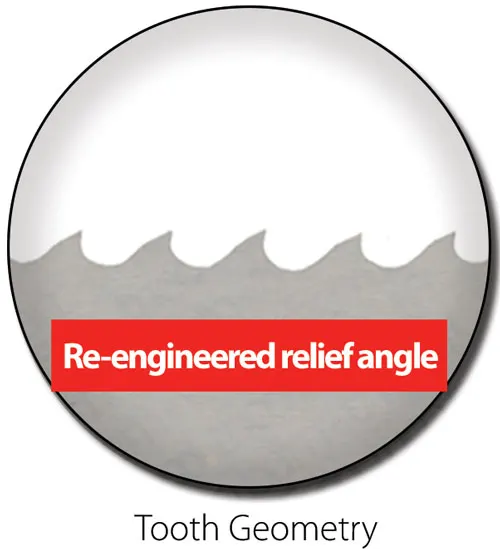
Qom is the TFI Co. M42 blade for the metals that wear ordinary bands out in a few cuts: Monel, Inconel, Hastelloy, titanium, stainless steel, tool steel and hardened copper alloys. A re-engineered relief angle, a high positive rake and teeth that vary in height and set give it a pulsating cutting action that keeps the edge biting where other blades start to rub.

Qom blade overview
| Cutting edge | M42 high-speed steel |
|---|---|
| Tooth hardness | Rc 67-69 |
| Tooth form | Re-engineered relief angle, high positive rake, duplex tooth with variable height and set, ground teeth |
| Widths x gauge | 19 x 0.9, 27 x 0.9, 34 x 1.1, 41 x 1.27, 54 x 1.6 mm |
| Pitches | Variable 2/3, 3/4 and 4/6 TPI |
| Coil length | 250 ft (about 76 m) |
| Machine requirement | Saws with hydraulic feed control |
| Best suited to | Nickel alloys, titanium, stainless, tool and high-speed steel, hardened copper and aluminium bronze |
- Cutting edge
- M42 high-speed steel
- Tooth hardness
- Rc 67-69
- Tooth form
- Re-engineered relief angle, high positive rake, duplex tooth with variable height and set, ground teeth
- Widths x gauge
- 19 x 0.9, 27 x 0.9, 34 x 1.1, 41 x 1.27, 54 x 1.6 mm
- Pitches
- Variable 2/3, 3/4 and 4/6 TPI
- Coil length
- 250 ft (about 76 m)
- Machine requirement
- Saws with hydraulic feed control
- Best suited to
- Nickel alloys, titanium, stainless, tool and high-speed steel, hardened copper and aluminium bronze
Qom is a production blade for shops that saw high-value alloys every day, where a blade that cuts accurately for longer saves more than it costs. It is the only M42 model offered in 54 x 1.6 mm for large-capacity machines.
Its ground, variable teeth also handle the toughness of stainless and the stickiness of bronze on the same machine without loading the gullets.
Construction and tooth geometry
Nickel and titanium alloys are tough, conduct heat poorly and work-harden quickly, so friction behind the edge turns straight into heat at the tip. Three features of the Qom tooth address that:
| High positive rake | The front face shears the chip with less force. |
|---|---|
| Engineered relief angle | Keeps the back of the tooth clear of the cut surface while leaving enough steel behind the tip to resist chipping. |
| Duplex tooth, variable height and set | Each tooth takes a deeper, narrower chip; the varying engagement creates a pulsating action that speeds penetration and breaks up vibration. |
| Ground teeth | A clean, accurate edge and smoother cutting faces. |
- High positive rake
- The front face shears the chip with less force.
- Engineered relief angle
- Keeps the back of the tooth clear of the cut surface while leaving enough steel behind the tip to resist chipping.
- Duplex tooth, variable height and set
- Each tooth takes a deeper, narrower chip; the varying engagement creates a pulsating action that speeds penetration and breaks up vibration.
- Ground teeth
- A clean, accurate edge and smoother cutting faces.
Relief is a trade-off. Too little and the tooth rubs; a much reduced relief strengthens the tip but shrinks the gullet. The Qom geometry balances tip strength against clearance for tough alloys.

Sizes, pitches and part numbers
All Qom strips come in 250 ft coils, variable pitches only; quote the TFI part number. Bulk coil quantities get good prices, and scheduled orders let alloy shops keep blades on hand without reordering each time.
| Width x gauge (mm) | Inch size | Coil | 2/3 TPI | 3/4 TPI | 4/6 TPI |
|---|---|---|---|---|---|
| 19.0 x 0.90 | 3/4 x .035 | 250 ft | Not listed | Not listed | TFI263 |
| 27.0 x 0.90 | 1 x .035 | 250 ft | TFI255 | TFI259 | TFI264 |
| 34.0 x 1.10 | 1-1/4 x .042 | 250 ft | TFI256 | TFI260 | TFI265 |
| 41.0 x 1.27 | 1-1/2 x .050 | 250 ft | TFI257 | TFI261 | TFI266 |
| 54.0 x 1.60 | 2 x .063 | 250 ft | TFI258 | TFI262 | TFI267 |
19.0 x 0.90
- Inch size
- 3/4 x .035
- Coil
- 250 ft
- 2/3 TPI
- Not listed
- 3/4 TPI
- Not listed
- 4/6 TPI
- TFI263
27.0 x 0.90
- Inch size
- 1 x .035
- Coil
- 250 ft
- 2/3 TPI
- TFI255
- 3/4 TPI
- TFI259
- 4/6 TPI
- TFI264
34.0 x 1.10
- Inch size
- 1-1/4 x .042
- Coil
- 250 ft
- 2/3 TPI
- TFI256
- 3/4 TPI
- TFI260
- 4/6 TPI
- TFI265
41.0 x 1.27
- Inch size
- 1-1/2 x .050
- Coil
- 250 ft
- 2/3 TPI
- TFI257
- 3/4 TPI
- TFI261
- 4/6 TPI
- TFI266
54.0 x 1.60
- Inch size
- 2 x .063
- Coil
- 250 ft
- 2/3 TPI
- TFI258
- 3/4 TPI
- TFI262
- 4/6 TPI
- TFI267

What Qom cuts best
Qom is built for production sawing of exotic and difficult materials, rated in the catalogue for steels and non-ferrous metals up to 40 HRC. Send the hardness with your enquiry if you are unsure.
| Material group | General sawing practice |
|---|---|
| Monel, Inconel, Hastelloy, high-alloy steels | Slow band speed, firm and constant feed, strong coolant |
| Titanium | Slow speed, steady pressure, generous water-soluble coolant; avoid low-flash-point neat oils |
| Stainless steels | Positive feed so the tooth never rubs |
| Tool steel and high-speed steel | Saw in the annealed condition, slow speed, coolant flow |
| Hardened copper, aluminium bronze | Coarse pitch and coolant to stop chips loading the gullets |
Monel, Inconel, Hastelloy, high-alloy steels
- General sawing practice
- Slow band speed, firm and constant feed, strong coolant
Titanium
- General sawing practice
- Slow speed, steady pressure, generous water-soluble coolant; avoid low-flash-point neat oils
Stainless steels
- General sawing practice
- Positive feed so the tooth never rubs
Tool steel and high-speed steel
- General sawing practice
- Saw in the annealed condition, slow speed, coolant flow
Hardened copper, aluminium bronze
- General sawing practice
- Coarse pitch and coolant to stop chips loading the gullets
These materials are costly, so accuracy matters as much as speed. A blade that wanders or glazes wastes expensive stock.
Choosing the TPI for Qom
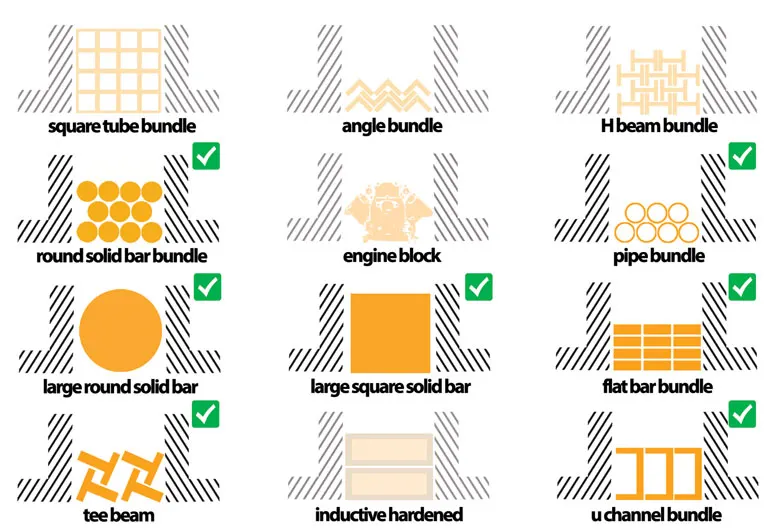
Tough alloys produce a long, hot chip, so Qom comes only in coarse variable pitches with room in the gullet.
| Qom pitch | Typical section | Strips |
|---|---|---|
| 2/3 TPI | Large solids, typically well above 100 mm across | 27 mm and wider |
| 3/4 TPI | Medium to large solids and heavy forgings | 27 mm and wider |
| 4/6 TPI | Smaller bar and thick-wall pipe | All widths, the only pitch on 19 mm |
2/3 TPI
- Typical section
- Large solids, typically well above 100 mm across
- Strips
- 27 mm and wider
3/4 TPI
- Typical section
- Medium to large solids and heavy forgings
- Strips
- 27 mm and wider
4/6 TPI
- Typical section
- Smaller bar and thick-wall pipe
- Strips
- All widths, the only pitch on 19 mm
On difficult alloys, err coarser. Too many teeth in a large section each take too thin a chip, rub instead of cutting and harden the surface.
Break-in and running tips
Break-in matters most on exotic alloys, because a tip chipped on the first cut rubs for the rest of the blade's life:
- Run the new band in on a softer steel if possible, at about half normal feed.
- Step the feed up over the next cuts.
- Only then move to the alloy job.
- Run band speeds well below mild-steel figures, with a firm, constant feed.
- Flood coolant at a strong concentration to carry heat away and flush the gullets.
- Never let the blade dwell in the cut; rubbing work-hardens nickel alloys in seconds.
- Read the chip: a thick, consistent curl means cutting; fine or discoloured chips call for slower speed and steadier feed.
Qom blades cut high-value stock, so we favour planned maintenance: replace bands on a fixed schedule of cuts or wear checks rather than after a failure that spoils a part. We help customers set that plan up.
Qom compared with BAM, Yazd and Kish
| Model | Tooth design | Sizes | When to use it instead of Qom |
|---|---|---|---|
| Qom (this blade) | Engineered relief angle, high positive rake, variable set | 19 to 54 mm | Not applicable |
| BAM | Straight teeth, 0° rake | 19 to 41 mm | Mild steel and general work, where Qom's tooth form brings no gain |
| Yazd | Strengthened teeth, positive rake | 19 to 41 mm | Structurals, medium alloy solids and everyday stainless |
| Kish | Dedicated tube-cutting teeth | 27 to 41 mm | Tubes and profiles in ordinary steels |
Qom (this blade)
- Tooth design
- Engineered relief angle, high positive rake, variable set
- Sizes
- 19 to 54 mm
- When to use it instead of Qom
- Not applicable
- Tooth design
- Straight teeth, 0° rake
- Sizes
- 19 to 41 mm
- When to use it instead of Qom
- Mild steel and general work, where Qom's tooth form brings no gain
- Tooth design
- Strengthened teeth, positive rake
- Sizes
- 19 to 41 mm
- When to use it instead of Qom
- Structurals, medium alloy solids and everyday stainless
- Tooth design
- Dedicated tube-cutting teeth
- Sizes
- 27 to 41 mm
- When to use it instead of Qom
- Tubes and profiles in ordinary steels
See all four blades side by side in the M42 bi-metal blade catalogue.
Qom blade questions
Can Qom cut Inconel and titanium?
Yes. Nickel alloys such as Monel, Inconel and Hastelloy, and titanium, are the materials Qom is designed for, in production sawing on hydraulically fed machines.
What is a relief angle?
It is the clearance angle behind the cutting tip. Enough relief stops the back of the tooth rubbing on the cut surface; too much weakens the tip. Qom's relief angle is engineered to balance the two for tough alloys.
Is Qom worth using on mild steel?
It will cut mild steel, but BAM or Yazd are the more economical choice there. Qom pays off on materials that wear standard blades quickly.
Why does my blade glaze on stainless or nickel alloy?
Glazing usually means the teeth are rubbing instead of cutting: feed pressure too light, band speed too high or too many teeth in the section. Slow the band, increase the feed to a firm, steady rate and move to a coarser pitch. A worn or chipped blade will also glaze, so check the tips.
Is there a hardness limit?
The catalogue rates Qom for steels and non-ferrous metals up to 40 HRC. Tell us the hardness of your material when you enquire.
Which sizes suit large production saws?
Qom comes in 41 x 1.27 mm and 54 x 1.6 mm for large machines, in 2/3, 3/4 and 4/6 TPI. Always match the width and gauge to your saw maker's specification.
Order Qom bandsaw blades online
Tell us the blade width x thickness, welded length or coil metres, TPI or TFI part number, alloy and hardness, section size, quantity and delivery emirate. Regular alloy cutters can set up a scheduled supply. Coolant liquid and bandsaw machines can join the same order.
- Section
- M42 Bi-Metal Bandsaw Blade Catalogue: BAM, Yazd, Qom and Kish
- Updated
- October 7, 2026
- Reading time
- 6 min read
Order or plan your blade supply
We appreciate scheduled orders, favour planned blade maintenance and offer good prices for bulk orders. Tell us what you need and our team replies by email.
Send an enquiry