

On this page9
The BAM blade is the general-purpose band in the TFI Co. M42 bi-metal catalogue, made for the mild steel and mixed metal cutting that keeps most UAE fabrication shops busy. Its straight teeth have a 0° rake face, giving a smooth, predictable cut across moderate to difficult materials. It comes in four widths from 19 to 41 mm and in more pitch options than any other model in the range.
BAM at a glance

| Construction | Bi-metal: M42 high-speed steel teeth on a flexible alloy-steel backing |
|---|---|
| Tooth hardness | Rc 67-69 |
| Tooth form | Straight teeth, 0° rake angle |
| Widths x gauge | 19 x 0.9, 27 x 0.9, 34 x 1.1, 41 x 1.27 mm |
| Pitches | Variable 3/4, 4/6, 5/8, 6/10, 8/12, 10/14 TPI; constant 10 TPI raker and 14 TPI wavy |
| Coil length | 250 ft (about 76 m) per coil |
| Best suited to | Mild steel, general metals, beams, channel, angle and thin-wall bundles |
- Construction
- Bi-metal: M42 high-speed steel teeth on a flexible alloy-steel backing
- Tooth hardness
- Rc 67-69
- Tooth form
- Straight teeth, 0° rake angle
- Widths x gauge
- 19 x 0.9, 27 x 0.9, 34 x 1.1, 41 x 1.27 mm
- Pitches
- Variable 3/4, 4/6, 5/8, 6/10, 8/12, 10/14 TPI; constant 10 TPI raker and 14 TPI wavy
- Coil length
- 250 ft (about 76 m) per coil
- Best suited to
- Mild steel, general metals, beams, channel, angle and thin-wall bundles
Construction and tooth geometry
Every BAM band is a true bi-metal blade. A strip of M42 cobalt high-speed steel is welded to a spring-tempered alloy backing, and only the tips are hardened. The result is a hard, heat-resistant edge on a body that flexes over the wheels without early fatigue.
The 0° rake, also called a regular tooth, sets the tooth face square to the direction of travel. It takes a slightly scraping cut that is gentle on the tip and unlikely to grab on interrupted sections such as beams and channel.
10 TPI raker set
Teeth alternate left, right and straight. The straight tooth clears the centre of the kerf, giving clean, square cuts in solids and flat bar.
14 TPI wavy set
Teeth are set in gentle waves. Many teeth share the load on a thin wall, so single teeth do not snag on tube or light sections.

Sizes, pitches and part numbers
All BAM strips come in 250 ft coils. Quote the TFI part number next to each pitch; combinations not listed are outside the standard range. Bulk coil orders get good prices, and we appreciate scheduled orders, so regular users can book a standing call-off.
| Width x gauge (mm) | Inch size | Coil | Variable pitch (TPI: part no.) | Constant pitch (TPI: part no.) |
|---|---|---|---|---|
| 19.0 x 0.90 | 3/4 x .035 | 250 ft | 6/10: TFI228; 8/12: TFI231; 10/14: TFI233 | 10 raker: TFI235; 14 wavy: TFI236 |
| 27.0 x 0.90 | 1 x .035 | 250 ft | 3/4: TFI221; 4/6: TFI223; 5/8: TFI226; 6/10: TFI229; 8/12: TFI232; 10/14: TFI234 | 14 wavy: TFI237 |
| 34.0 x 1.10 | 1-1/4 x .042 | 250 ft | 3/4: TFI222; 4/6: TFI224; 5/8: TFI227; 6/10: TFI230 | None listed |
| 41.0 x 1.27 | 1-1/2 x .050 | 250 ft | 4/6: TFI225 | None listed |
19.0 x 0.90
- Inch size
- 3/4 x .035
- Coil
- 250 ft
- Variable pitch (TPI: part no.)
- 6/10: TFI228; 8/12: TFI231; 10/14: TFI233
- Constant pitch (TPI: part no.)
- 10 raker: TFI235; 14 wavy: TFI236
27.0 x 0.90
- Inch size
- 1 x .035
- Coil
- 250 ft
- Variable pitch (TPI: part no.)
- 3/4: TFI221; 4/6: TFI223; 5/8: TFI226; 6/10: TFI229; 8/12: TFI232; 10/14: TFI234
- Constant pitch (TPI: part no.)
- 14 wavy: TFI237
34.0 x 1.10
- Inch size
- 1-1/4 x .042
- Coil
- 250 ft
- Variable pitch (TPI: part no.)
- 3/4: TFI222; 4/6: TFI224; 5/8: TFI227; 6/10: TFI230
- Constant pitch (TPI: part no.)
- None listed
41.0 x 1.27
- Inch size
- 1-1/2 x .050
- Coil
- 250 ft
- Variable pitch (TPI: part no.)
- 4/6: TFI225
- Constant pitch (TPI: part no.)
- None listed

What BAM cuts best
BAM is an all-purpose band for moderate to difficult materials, with mild steel and general carbon steels as its home ground. Typical work includes:
- H beams and I beams
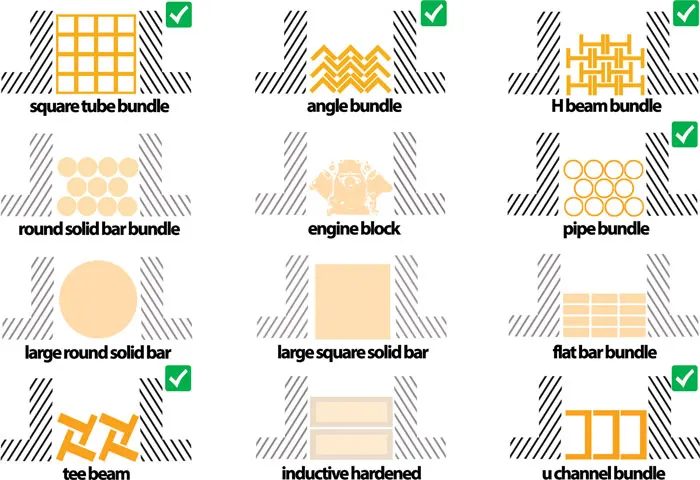
- U channel and angle, cut singly or in bundles
- Thin-wall square and round tube bundles
- Thin pipe bundles
- Flat bar and small solid bar
For heavily alloyed solids, stainless steel that work-hardens, or nickel and titanium alloys, a positive-rake model will usually cut faster and last longer. BAM remains the sensible default when the material mix is broad and the priority is a steady, reliable cut.
Choosing the right TPI for BAM
Pick the pitch from the thickness the teeth actually pass through: the wall or flange on tube and beams, the full diameter or width on solids.
| BAM pitch | Typical work |
|---|---|
| 3/4 TPI | Larger solids and heavy sections with high chip volume |
| 4/6 and 5/8 TPI | Medium solids, beams and mixed bundles; the best single-blade start |
| 6/10 and 8/12 TPI | Smaller solids, thicker-wall tube and channel |
| 10/14 TPI and 10 TPI raker | Small bars and thin sections needing more teeth in contact |
| 14 TPI wavy | Thin-wall tube and light profiles; the wavy set reduces snagging |
3/4 TPI
- Typical work
- Larger solids and heavy sections with high chip volume
4/6 and 5/8 TPI
- Typical work
- Medium solids, beams and mixed bundles; the best single-blade start
6/10 and 8/12 TPI
- Typical work
- Smaller solids, thicker-wall tube and channel
10/14 TPI and 10 TPI raker
- Typical work
- Small bars and thin sections needing more teeth in contact
14 TPI wavy
- Typical work
- Thin-wall tube and light profiles; the wavy set reduces snagging
Keep at least three teeth in the cut on thin walls, and six to twelve where possible. Drop to a coarser pitch if chips pack the gullets or turn blue.
Break-in and running tips
A new band has razor-sharp tips that chip easily if pushed hard straight away. Honing them gently adds noticeably to blade life:
- Set the band speed you would normally use for the material. General charts put bi-metal blades on low-carbon steel at roughly 75 to 85 m/min with coolant.
- Cut at about half the normal feed for the first few hundred square centimetres.
- Raise the feed in steps over the next cuts while watching the chips.
| Chip you see | What it means | Adjust |
|---|---|---|
| Loose, silvery curls | Feed and speed are right | Nothing |
| Fine, powdery chips | Teeth rubbing, feed too light | Increase feed |
| Thick, heavy or blue chips | Teeth overloaded or running hot | Reduce feed or speed; check coolant |
| Chips packed in gullets | Too many teeth for the section | Move to a coarser pitch |
Loose, silvery curls
- What it means
- Feed and speed are right
- Adjust
- Nothing
Fine, powdery chips
- What it means
- Teeth rubbing, feed too light
- Adjust
- Increase feed
Thick, heavy or blue chips
- What it means
- Teeth overloaded or running hot
- Adjust
- Reduce feed or speed; check coolant
Chips packed in gullets
- What it means
- Too many teeth for the section
- Adjust
- Move to a coarser pitch
- Tension the band to the saw maker's figure; a slack band wanders and cuts out of square.
- Use bandsaw coolant at the correct concentration. TFI Co. supplies coolant liquid made for bandsaw machines.
- Set the guides close to the work and keep the chip brush working so chips are not re-cut.
We favour planned maintenance: change BAM bands on a schedule of cutting hours or wear checks, not after a breakage. We can help you set that schedule up.
BAM compared with Yazd, Qom and Kish
| Model | Rake and tooth design | Choose it when |
|---|---|---|
| BAM (this blade) | Straight teeth, 0° rake | You cut mostly mild steel and mixed general sections |
| Yazd | Strengthened teeth, positive rake | You cut structurals, thick-wall tube, medium alloy solids or stainless |
| Qom | Engineered relief angle, high positive rake | You saw super alloys, titanium, tool steel or copper alloys in production |
| Kish | Dedicated tube-cutting teeth | Tubes and profiles are breaking or stripping teeth |
BAM (this blade)
- Rake and tooth design
- Straight teeth, 0° rake
- Choose it when
- You cut mostly mild steel and mixed general sections
- Rake and tooth design
- Strengthened teeth, positive rake
- Choose it when
- You cut structurals, thick-wall tube, medium alloy solids or stainless
- Rake and tooth design
- Engineered relief angle, high positive rake
- Choose it when
- You saw super alloys, titanium, tool steel or copper alloys in production
- Rake and tooth design
- Dedicated tube-cutting teeth
- Choose it when
- Tubes and profiles are breaking or stripping teeth
Return to the M42 bi-metal blade catalogue to compare all four models.
BAM blade questions
What is a 0° rake angle and why choose it?
The tooth face stands square to the cutting direction. It gives a stable, smooth cut, is kind to the tooth tips on interrupted sections such as beams, and suits general work where the material changes often.
Can BAM cut stainless steel?
It can handle occasional stainless work, but for regular stainless cutting the positive rake of the Yazd model reduces work hardening and usually gives better blade life.
Which BAM pitch should I stock if I can only keep one?
For a general fabrication shop cutting beams, channel and medium bars, 5/8 or 4/6 TPI in 27 x 0.9 mm covers the widest range. Use 14 TPI wavy if most of your work is thin-wall tube.
Is the 41 mm blade 1.3 or 1.27 mm thick?
The 1-1/2 inch strip is 0.050 inch gauge, which is 1.27 mm; it is often rounded to 1.3 mm. Check that your saw accepts a 41 mm width before ordering.
Do you supply in bulk for factories and dealers?
Yes. TFI Co. supplies factories with several bandsaw machines and dealers in the Middle East, North Africa and South Asia. Give your expected volumes in the order form.
Order BAM bandsaw blades online
Include the blade width x thickness (for example 27 x 0.9 mm), welded length or coil metres, TPI or TFI part number, material cut, quantity and delivery emirate. Ask about a scheduled supply if you reorder BAM regularly.
- Section
- M42 Bi-Metal Bandsaw Blade Catalogue: BAM, Yazd, Qom and Kish
- Updated
- October 7, 2026
- Reading time
- 6 min read
Order or plan your blade supply
We appreciate scheduled orders, favour planned blade maintenance and offer good prices for bulk orders. Tell us what you need and our team replies by email.
Send an enquiry